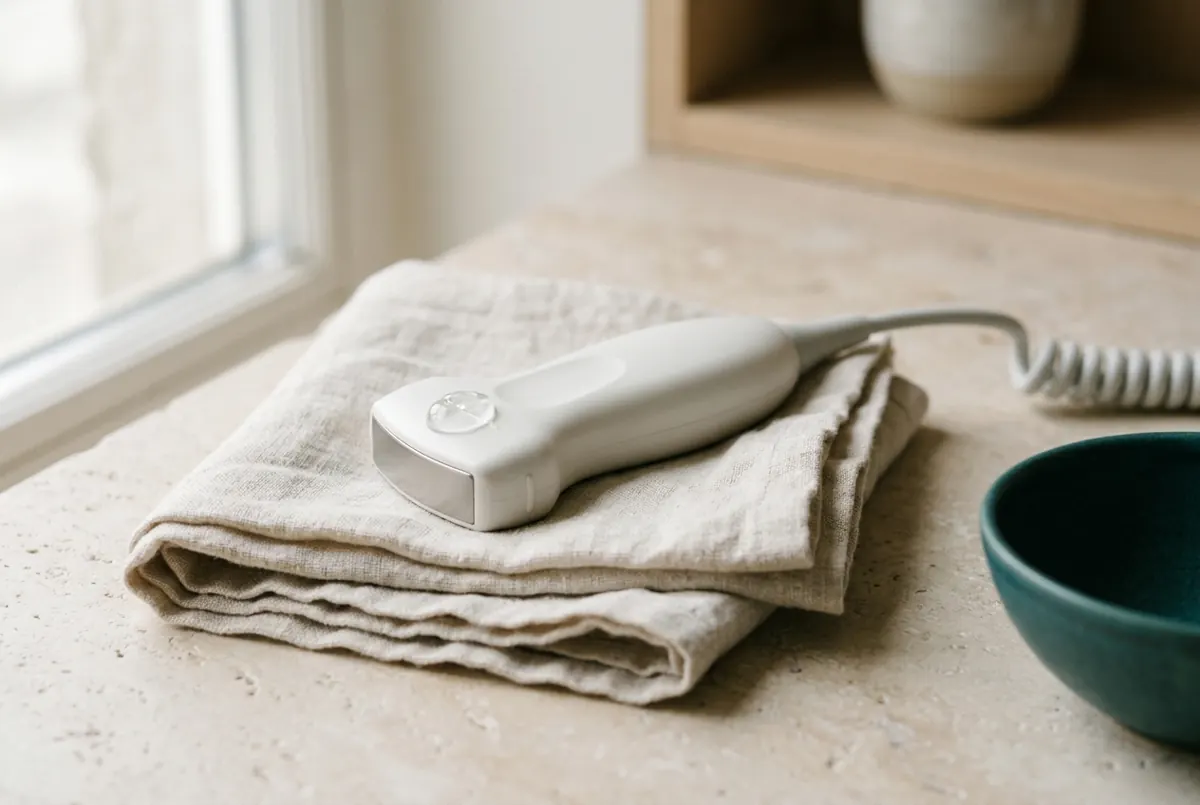
Ultherapy is the commercial name for ultrasound therapy that aims focused ultrasound energy beneath the skin's surface to stimulate new collagen.1 The FDA lists the device as the Ulthera System, made by Ulthera, Inc.2
Here is what the FDA has cleared it for, what the American Society for Dermatologic Surgery says to expect, and what to ask. Whether to have it is for you and a clinician.
What it is
The ultrasound is delivered to planned depths within the tissue beneath the skin. It bypasses the surface and reaches the deeper layers where collagen lives, which prompts the body's own collagen response.1 It is typically used on the brow, the neck and under the chin, and it is non-surgical and can be done in a doctor's office.1
What the FDA has cleared
The FDA's 510(k) database lists clearances for the Ulthera System going back to 2012. We read the clearance summaries from 2018, 2025 and 2026.2 The FDA describes the intended use as applying focused ultrasound energy to the body to achieve temporary changes in the physical appearance of the skin.2
The indications are as follows. The 2018 clearance lists the first three. The 2025 clearance adds the abdomen and arms, and the 2026 clearance adds the knees.2
What the Ulthera System is cleared to do
- Lift the eyebrow
- Lift lax tissue under the chin and in the neck
- Improve lines and wrinkles of the chest (the décolleté)
- Improve the appearance of skin laxity on the abdomen and the front and back of the arms
- Improve the appearance of skin laxity on the knees
The system also has an imaging transducer, which lets the provider see the skin's layers to a depth of 8 mm, to check the transducer is in good contact and the depth is right to avoid bone.2
These are clearances, which are not the same as approvals. They find a device substantially equivalent to one already on the market.2 The FDA's documents don't use the word Ultherapy. We link the two through the dermatologic surgeons' society, which names Ultherapy as the commercial name of the treatment.1
Myth
Ultherapy is FDA-approved to tighten the whole face and body.
Fact
The FDA clears the Ulthera System for specific uses: lifting the eyebrow, lax tissue under the chin and in the neck, chest lines and wrinkles, and skin laxity on the abdomen, arms and knees. These are clearances, not approvals.
The visit and what to expect
Before the procedure the doctor reviews your medical history and goes over expectations and risks. No preparation is needed, though your doctor may suggest pain medication beforehand.1 The area is cleansed, gel is applied and a handpiece is placed on the skin. The visit can last up to 30 to 90 minutes depending on the areas, and you can feel discomfort while the energy is delivered.1
The society says most patients need only one procedure, though some benefit from more, depending on their response and how much laxity they have.1 Its timeline, which is the society's and not a measured result, is below.
What the dermatologic surgeons' society says to expect
- Right afterFlushed skin
Temporary flushing. Some patients see an immediate effect.
- A few weeksTingling or tenderness
Mild and temporary tingling or tenderness to the touch.
- 2 to 3 monthsLifting and toning
The ultimate lifting and toning takes place over these months.
- Up to 6 monthsMore improvement
Additional improvements can appear up to six months after the procedure.
- Up to a yearHow long it lasts
The society says the effects can last up to a year, and follow-up treatments can be done.
Risks
The society lists mild and temporary swelling, tingling or tenderness to the touch, and says the risks are minimized in the hands of a qualified ASDS dermatologist.1 That is a society recommending its own members, so weigh it accordingly.
At the clinics we list
749 of the 7,475 med spas we list name Ultherapy. That doesn't show who does the treatment or how often, so ask.3
Which licensed professionals may do it depends on your state. See our guide to who may inject.
Here is what to bring to a consultation.
Questions to bring
The device and the person
Me and the plan
Cost
We don't give prices on this page.
Find clinics
Each listing shows what the clinic’s own website offers, its Google reviews and its hours. No clinic is graded yet.
Common questions
What is Ultherapy?
The commercial name for ultrasound therapy, which sends focused ultrasound energy beneath the skin's surface to stimulate collagen. It is non-surgical and can be done in a doctor's office.
Is Ultherapy FDA-approved?
It is FDA-cleared, which isn't approval. The Ulthera System is cleared to lift the eyebrow and lax tissue under the chin and neck, to improve chest lines, and to improve skin laxity on the abdomen, arms and knees.
How long do Ultherapy results take?
According to the American Society for Dermatologic Surgery, lifting and toning develop over two to three months, with more improvement for up to six months.
What are the side effects of Ultherapy?
The society lists mild, temporary swelling, tingling and tenderness. Most people have temporary flushed skin afterward.
Sources (3)
- ASDS, Ultrasound Therapy for Sagging Skin · American Society for Dermatologic Surgery (ASDS), a professional society of dermatologic surgeons · read 29 Oct 2026
- FDA 510(k) summary K260618, Ulthera System (cleared 2026-05-21) · US Food and Drug Administration, 510(k) database. Read with K250418 (cleared 2025-05-13) and K180623 (cleared 2018-05-04), all by Ulthera, Inc. The database lists 14 Ulthera entries, including a 2009 De Novo (DEN080006) that was not read. · read 29 Oct 2026
- Clinic websites: what they say on their own pages · Our own read of listed clinics' websites in the 14 states we cover, October 2026. A clinic counts once. · read 29 Oct 2026